Insights
Turning AI Safety Commitments into Everyday Decisions
At All Tech Is Human’s Responsible Tech Summit, Cinder Co-Founder and COO Phil Brennan joined leaders for a safety-by-design panel.
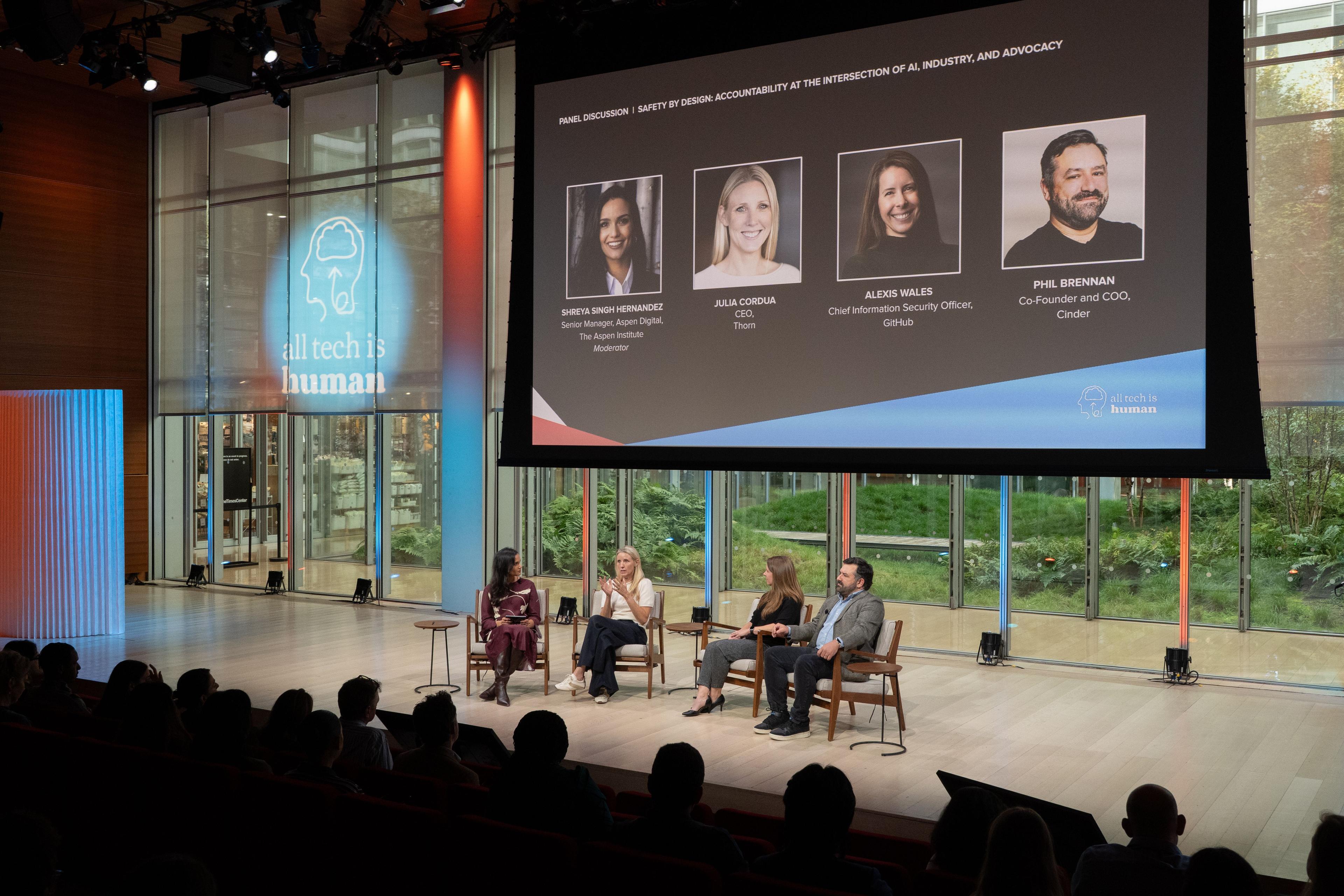
How do we move from agreeing on responsible AI principles to making them part of how technology is built? At All Tech Is Human’s Responsible Tech Summit, Cinder Co-Founder and COO Phil Brennan joined leaders to explore the practical decisions that can turn safety commitments into accountability.
The summit, held at The Times Center in Manhattan, centered on “Embedding Accountability in the AI Era.” Shreya Singh Hernandez of Aspen Digital at The Aspen Institute moderated the safety-by-design panel, which brought Brennan together with Thorn CEO Julie Cordua and GitHub Chief Information Security Officer Alexis Wales.
Make the business value of safety visible
Brennan said that during his early years at Facebook, his team there missed an opportunity to establish a clear financial value for safety.
Safety teams have often had to justify their work as a cost. Brennan argued that drawing a stronger connection between safety and business outcomes could have changed how companies prioritized investment. A clear financial case gives executives a concrete reason to care about Trust and Safety alongside growth and performance metrics.
Today, litigation is making some of those costs visible, but Brennan’s point reached beyond legal exposure. Companies need to understand safety’s value early enough to shape what they build and how they resource it.
Cordua reinforced that point by calling for product managers to own safety metrics from the start. Wales compared Trust and Safety to cybersecurity and argued that safety teams deserve the same board attention, budgets, and shared understanding of risk that cybersecurity teams spent years building.
Help companies learn from one another
Brennan also contrasted Trust and Safety with cybersecurity. Security teams routinely share actionable threat information across companies, he said, while data privacy rules limit what Trust and Safety teams can share.
A security team can warn another organization about a piece of malware without necessarily revealing personal user data. Sharing information about an abusive network is more complicated, particularly when it involves identifying people across platforms.
That creates a practical challenge. Threats move between services, while the information needed to recognize them stays siloed. Brennan acknowledged the privacy constraints and pointed to incremental progress, including the Global Internet Forum to Counter Terrorism’s work on information sharing.
Trust and Safety must develop ways for companies to recognize common threats and act earlier, while still respecting the data protections that make those exchanges difficult.
Bring adversarial expertise into product development
Developers focused on a product’s benefits may overlook how someone could exploit it. Experienced adversarial practitioners look at the same features and spot likely abuse before it becomes an incident.
That expertise matters most when prevention is hard to measure. Brennan, whose background includes counterterrorism work, described a familiar challenge from that field: interpreting an absence of harm. Does nothing happening mean the safeguards worked, or that something was missed?
Baseline protections and informed scrutiny can help companies act despite that uncertainty.
Build on the progress already happening
Brennan closed on an encouraging note: experienced Trust and Safety professionals are joining AI companies early, while products and organizations are still taking shape and risks are easier to address.
Cordua shared that optimism and pointed to larger AI companies that are building child protection expertise in from the start. Wales highlighted GitHub’s closer collaboration between safety and security teams, including shared tools and engineering resources.
Brennan also urged the field to keep immediate harms in view while planning for longer-term AI risks.
Together, the panelists made the case that accountable AI starts with everyday decisions: who owns safety, how it is funded, and whose expertise shapes a product before it reaches users.
Read more articles

Why Open-Weight Models Need Their Own User Safety Layer (and What It Should Cover)
Is that a trick or a treat? Halloween changes the context for Trust and Safety teams
How Leading Open-Weight Models Respond to Requests Involving Violent Harm

Generative media is becoming infrastructure. Safety must keep pace.
Can Jev Answer Trust and Safety's Hardest Questions?
The Coolest Job At The Dinner Party: Why I Joined Cinder
AI as an Overwhelming Security Vector Requires a New Defensive Posture
Who gets to decide when AI is safe?
What Is AI Red Teaming?
AI Safety Is the Goal. Safeguards Are the Work.
The Real AI Safety Problem Is Already Here
The Best AI Starts with Human Judgment
AI Has Changed Our Tools, Not Our Standards
What Cinder Learned Red Teaming Alibaba’s Latest Open-Weight Model

Every Child Safety Report Is a Handoff
AI Is Lowering the Barrier to Online Abuse. Platforms Need to Raise Their Defenses.
The Human Cost of a Safer Internet
Navigating Trust and Safety in Online Marketplaces
AI Agents Are Now the Only Way to Moderate Content at Scale