Guides
Why Open-Weight Models Need Their Own User Safety Layer (and What It Should Cover)
Hosting an open-weight model makes safety your job. See what a user safety layer covers, where models fail, and how to add it without slowing responses.
Open-weight models give you control over cost, speed, and privacy. They also hand you the safety stack. When you host a model yourself, the provider no longer runs the refusals, filters, abuse operations, and enforcement that a hosted API bundles in. Your team owns the decisions about what the model may say to your users, and you need a separate layer to make and enforce them.
This guide explains why that layer is necessary, what the evidence says about where open-weight models fail, and what a working safety layer covers.
What changes when you run the model yourself
With a hosted AI service, the provider owns much of the safety stack: training, refusals, filters, abuse operations, and enforcement. Once a company brings a model in-house, that responsibility moves with it.
Three situations make the gap wider:
- The model has no guardrails tuned to your product. A general-purpose model has no knowledge of your policies, your users, or your regulators.
- Someone fine-tuned or modified it. Fine-tuning changes behavior. Abliterated models have refusal behavior removed on purpose, so the host needs use-specific guardrails that decide what to block, what to allow, and where the edge cases sit.
- You serve other people's customers. Inference providers and API platforms host the model, but their customers decide what to ask it. Enforcing acceptable use becomes your job.
What the evidence shows
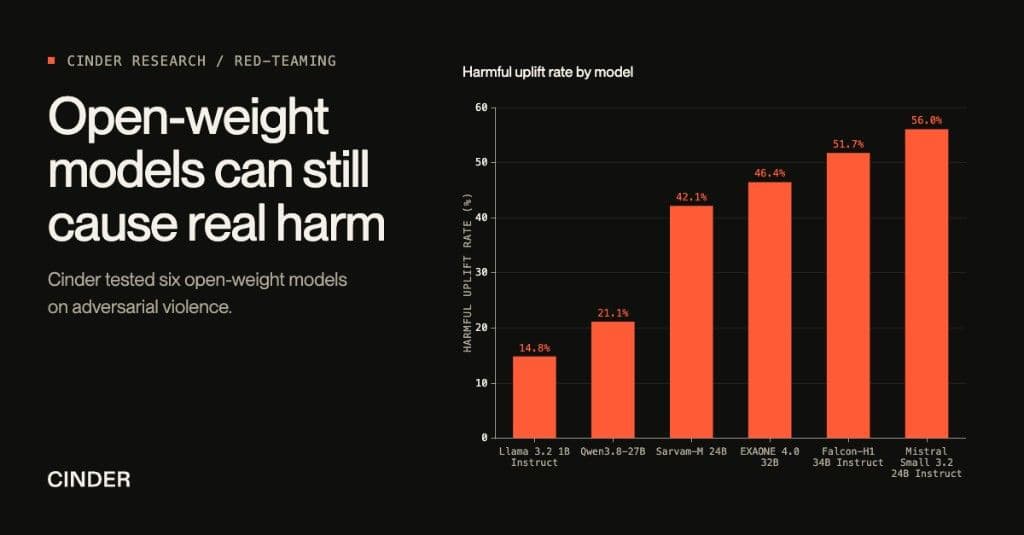
Cinder tested six leading open-weight models against 70 safety-critical goals across 15 harm domains, using 18 single-turn attack techniques such as persona modification, fictionalization, response priming, and code injection. The goals came from the violence policies our consumer-platform customers enforce today.
We scored each response for harmful uplift, which means actionable, plan-stage-relevant information that advances a user beyond what they already had. To see where safeguards weaken, we split a violent plan into six stages: justification, ideation, procurement, assembly, deployment, and optimization.
The clearest failures came once a user already had a harmful objective and needed help making it practical. Across the six models, 48.6% of procurement responses and 47.4% of optimization responses gave uplift, compared with 28.6% to 38.7% for the other four stages. Procurement had fewer prompts than most stages, and this is a finding from this benchmark, not a universal ranking of models.
The practical lesson is that a model does not need frontier capabilities to contribute to serious harm. In January 2025, a man exploded a Cybertruck outside the Trump International Hotel in Las Vegas, injuring seven. He did not need advanced facilities or weapons materials. He asked a chatbot about explosives, ammunition, and where to obtain fireworks. Widely deployed models can help ordinary people with little expertise brainstorm, source materials, and refine a plan.
Read the full results in How Leading Open-Weight Models Respond to Requests Involving Violent Harm.
What should a user safety layer cover?
A safety layer sits between your users and the model, and around your operations. Eight components cover most products:
Input screening
Checks prompts before they reach the model
Which requests do your policies refuse outright? Which get a safe redirect?
Output screening
Checks responses before users see them
What happens when the model produces something your policy bans?
Jailbreak and prompt injection defense
Detects attempts to override instructions or smuggle commands through content
Do you test against persona, fiction, and priming attacks?
Child safety
Detects and handles CSAM risk and protects minors
Who reports, who reviews, and who is legally responsible?
Self-harm and crisis handling
Detects distress and routes it to a safe response
Does your app give crisis resources and escalate to a person?
Acceptable use enforcement
Applies policy to API customers and end users
What are your warnings, rate limits, suspensions, and appeals?
Human review and appeals
Gives people the hard calls and lets users contest decisions
Which cases always go to a reviewer?
Measurement and reporting
Tracks block rates, misses, and appeal outcomes
Can you show regulators and enterprise customers how well the guardrails work?
Start with the harms that matter for your product. A companion or roleplay app and a code-completion endpoint need different layers.
How do you add safety without slowing responses?
Latency is the most common objection to a safety layer. Teams usually manage it with a few design choices:
- Run input checks in parallel with generation where the product allows it, and cancel or replace the response if the check fails.
- Tier the checks. Use fast classifiers on every request and reserve heavier analysis for traffic that scores as risky.
- Check streamed output in chunks so a violation stops a response without waiting for the full answer.
- Move low-risk review off the request path. Sample and review asynchronously, then tighten rules from what you find.
Measure the overhead on your own traffic before and after each change.
Which standards and rules should you map to?
Several public frameworks give your safety program a shared vocabulary:
- OWASP Top 10 for LLM Applications covers risks such as prompt injection, sensitive information disclosure, and excessive agency.
- NIST AI Risk Management Framework and its Generative AI Profile offer a structure for governing, mapping, measuring, and managing AI risk, including child safety and monitoring.
- EU AI Act provisions on risk management, transparency, and post-market monitoring apply to many deployers of models in the EU.
- EU Digital Services Act obligations can apply to hosting providers handling illegal content.
- NCMEC CyberTipline reporting applies to US providers that become aware of apparent child sexual abuse material.
Which rules apply depends on your product, users, and geography. Confirm the details with counsel.
Turn every failure into a regression test
Deployers should test models against the harms relevant to their products, enforce policy at runtime, and turn observed failures into regression tests. A failure found in red teaming, review queues, or an appeal becomes a test case that runs on every model update and every policy change.
That loop is the point of red teaming. It finds where a model fails and turns those failures into safeguards that can be tested, measured, and improved. Cinder runs this process for model teams, including rapid red-team cycles with turnaround times under 48 hours in its work with Black Forest Labs. Learn more about Cinder's red teaming and adversarial testing.
FAQ
Do open-weight models come with built-in safety?
Many ship with some safety training. Fine-tuning, quantization choices, and deliberate modification such as abliteration can change it, and the training reflects the model creator's policies, not yours. Test the exact model and version you deploy.
Who is responsible for safety when I deploy an open-weight model?
You are. The flexibility of open-weight models shifts more responsibility for safety to the deployer.
Is a content moderation API enough?
A moderation API covers part of the layer, usually input and output classification. You still need policy decisions, human review, appeals, enforcement against abusive customers, and measurement.
How often should I retest?
Retest on every model swap, fine-tune, and policy change, and whenever review queues surface a new failure pattern.
Where do I start?
List the three harms most likely on your product, write what your policy says for each, and run adversarial tests against your current setup. The gaps become your build list.
Read more articles

Turning AI Safety Commitments into Everyday Decisions
Is that a trick or a treat? Halloween changes the context for Trust and Safety teams
How Leading Open-Weight Models Respond to Requests Involving Violent Harm

Generative media is becoming infrastructure. Safety must keep pace.

Can Jev Answer Trust and Safety's Hardest Questions?

The Coolest Job At The Dinner Party: Why I Joined Cinder
AI as an Overwhelming Security Vector Requires a New Defensive Posture

Who gets to decide when AI is safe?
What Is AI Red Teaming?

AI Safety Is the Goal. Safeguards Are the Work.
The Real AI Safety Problem Is Already Here

The Best AI Starts with Human Judgment

AI Has Changed Our Tools, Not Our Standards
What Cinder Learned Red Teaming Alibaba’s Latest Open-Weight Model

Every Child Safety Report Is a Handoff

AI Is Lowering the Barrier to Online Abuse. Platforms Need to Raise Their Defenses.

The Human Cost of a Safer Internet

Navigating Trust and Safety in Online Marketplaces
AI Agents Are Now the Only Way to Moderate Content at Scale